Kemalist Nationalism
Doctrine of Mustafa Kemal Atatürk that founded modern Turkey on six arrows: republicanism, nationalism, populism, statism, laicism and reformism, imposing Westernization and state control of religion from above.
Home / Ideologies / Kemalist Nationalism
Doctrine of Mustafa Kemal Atatürk that founded modern Turkey on six arrows: republicanism, nationalism, populism, statism, laicism and reformism, imposing Westernization and state control of religion from above.
In one sentence
I want a secular, modern Turkish republic, with religion under state control, one national identity and industry built by the state.
Political axes
Leans further toward assimilation than 88% of the 248 ideologies in the catalog.
Of all the axes, Immigration is where it stands furthest from the rest.
On Intervention, it sits practically at the catalog median.
Here it shares common ground with most ideologies.
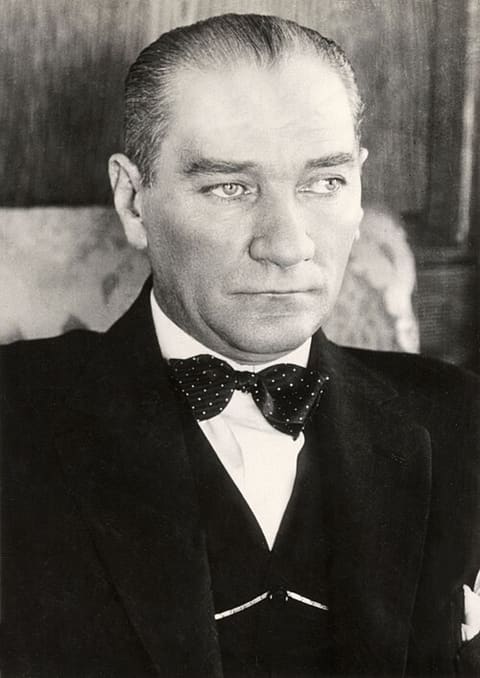
Founder of modern Turkey, Atatürk imposed radical modernization from above, with secularization, a new alphabet, civil rights for women, and developmentalist nationalism, breaking with the Ottoman and religious heritage.
Closest, by dimension

Other compatible profiles

The most distant
Reference country
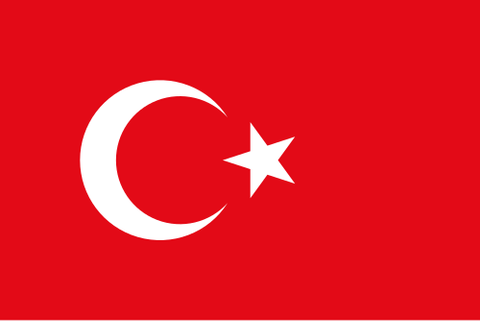
A republic founded by Mustafa Kemal Atatürk on the ruins of the Ottoman Empire, Kemalist Turkey abolished the caliphate and imposed laicism, the Latin alphabet, women's rights, and economic statism under the single-party CHP.
Other close countries

A single-party socialist state, Vietnam maintains the Communist Party's political control alongside market reforms that opened the economy, promoting rapid industrial growth and integration into global trade.
Also close, by dimension


The most distant
A republic founded by Mustafa Kemal Atatürk on the ruins of the Ottoman Empire, Kemalist Turkey abolished the caliphate and imposed laicism, the Latin alphabet, women's rights, and economic statism under the single-party CHP.
Also close, by dimension
The most distant
Ideological proximity
Closest within Third Position
An Arab current of state socialism combining pan-Arab nationalism, a vanguard party, planning, land reform and control of strategic sectors, advocating Arab unity, secularism and independence from imperialism.
Justicialist doctrine of Juan and Eva Perón uniting political sovereignty, economic independence and social justice, with CGT unions, nationalizations, protected industrialization, social Catholicism and a charismatic leader above parties.
Syncretic ideology, also called NazBol, that fuses revolutionary socialism and radical nationalism, combining a collectivist economy, state authoritarianism, and rejection of liberalism, the West, and bourgeois individualism.
Closest in other spectrums
Model of the Communist Party of Vietnam uniting Ho Chi Minh Thought, anticolonial national liberation and the 1986 Đổi Mới: single-party rule, a socialist-oriented market economy, a dominant state sector and openness to global trade.
Model in which the state directs industrialization and economic growth through planning, public investment, and industrial protection, seeking to overcome the nation's backwardness and external dependence.
Current inspired by Auguste Comte that trusts science and reason to organize society, defending order, progress, and technical administration guided by knowledge in place of metaphysics and tradition.
The most distant ideology
Progressive LibertarianismLibertarian33%