Malthusianism
Doctrine inspired by Malthus that proposes curbing population growth through late marriage, education and family responsibility, replacing poor relief with work incentives and protecting property and national agriculture.
Home / Ideologies / Malthusianism
Doctrine inspired by Malthus that proposes curbing population growth through late marriage, education and family responsibility, replacing poor relief with work incentives and protecting property and national agriculture.
In one sentence
I want responsible families, late marriage and moral education, replacing poor relief with work incentives, with property and agriculture protected.
Political axes
Leans further toward private than 91% of the 264 ideologies in the catalog.
Of all the axes, Economy is where it stands furthest from the rest.
On Intervention, it sits practically at the catalog median.
Here it shares common ground with most ideologies.
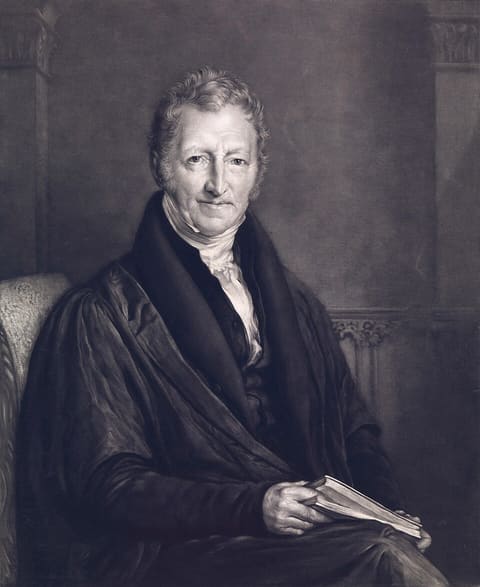
Anglican cleric and British economist, author of An Essay on the Principle of Population (1798): he argued that population outgrows food supply and defended moral restraint and reform of the Poor Laws.
Closest, by dimension


Other compatible profiles







The most distant
Reference country

At its Victorian height, the British Empire was the largest in history, uniting parliamentary monarchy, the industrial revolution, and global colonial rule, with strong commercial, naval, and cultural expansion across the world.
Other close countries

A southern state with strong agribusiness and European immigrant settlement, Paraná combines a thriving agricultural and industrial economy with a mostly conservative, economically liberal electorate.
Also close, by dimension

The most distant

Lutheran German state with pioneering manufacturing and mining, a Catholic dynasty, and parliamentary traditions inside the German Confederation and Empire.
Also close, by dimension


The most distant
Ideological proximity
Closest within Right
Political tradition that values order, customs, family, and consolidated institutions, preferring gradual and prudent change over rupture, based on historical experience and skepticism toward utopias.
Current that grounds politics in Christian morality and tradition, defending family, life, and religious values within democracy, with emphasis on preserving the people's customs and cultural heritage.
Platform of the Republican Party, combining border security and deportations, tariffs and industrial protectionism, tax cuts and deregulation, gun rights, Christian values and returning abortion to the states.
Closest in other spectrums
Centrist branch that combines economic moderation and institutional respect with social conservatism, valuing family, religion, order, and gradual change without joining the authoritarian right or populist radicalism.
Branch that unites conservatism and environmental protection, defending the preservation of nature as part of the tradition and heritage to be passed on to future generations, with prudence toward change.
Tradition of republics made of sovereign provinces or cantons, such as the Dutch Republic and the old Swiss Confederacy, with local self-government, open trade, armed neutrality and deep-rooted Protestant faith.
The most distant ideology
Techno-CommunismAnarchist24%